SumUp Now Pays Up to 5% Cashback — Here’s How It Works
SumUp now pays up to 5% cashback, including 5% at SumUp businesses, 2% at supermarkets and 0.5% elsewhere. Here’s how it works, how to stack it, and whether it’s worth using.
So, I got an email from SumUp today.
The SumUp Pay app is now just called SumUp, they’ve updated the branding, and there’s a new pink virtual card in the app.
But the part of the email that actually caught my attention was the cashback.
SumUp says you can now earn up to 5% cashback when spending with the SumUp Mastercard, capped at £10 per month.
That’s a strong headline, and on the surface it sounds like a pretty decent offer.
I’ll be honest though — I haven’t used SumUp much since they stopped being useful for cashback stacking.
Last year, you could add SumUp into a payment chain, where one card charged another and you could earn cashback from multiple layers. For example:
£50 spend at Amazon → pay with Zilch (2%) → Zilch charges Curve (1%) → Curve charges SumUp Pay (0.5%)
For a while, that made SumUp genuinely interesting. But once the system changed and cashback no longer passed through reliably, I switched my cashback stack to a different setup.
So this new 5% headline definitely got my attention.
After doing a bit of digging though, it’s not quite as simple as “5% cashback everywhere”.
Before we all start throwing every transaction through SumUp and calling it a day, there are a few things worth knowing.
How the new SumUp cashback works
SumUp now pays cashback at three different rates:
Spend type | Cashback rate |
|---|---|
SumUp businesses | 5% |
Supermarkets | 2% |
Everywhere else | 0.5% |
Monthly cashback cap | £10 |
SumUp says cashback is capped at £10 per calendar month, and excludes things like gambling transactions, crypto purchases and topping up a wallet with another provider.
The good news is that this is proper low-effort cashback.
There’s no activating retailer offers.
No minimum spend.
No waiting around for a cashback site to track.
No “pending for 60 working days”
You just spend with the card and the cashback builds up inside the app.
The catch: finding 5% SumUp cashback retailers
Here’s the slightly awkward bit.
SumUp says you can earn 5% cashback at any business that uses SumUp to accept card payments, which it says covers over 4 million small businesses worldwide. That sounds great on paper.
But right now, there still doesn’t seem to be a proper way to search for those businesses before you spend.
The Rewards tab shows the cashback categories:
5% at small businesses
2% at supermarkets
0.5% everywhere else
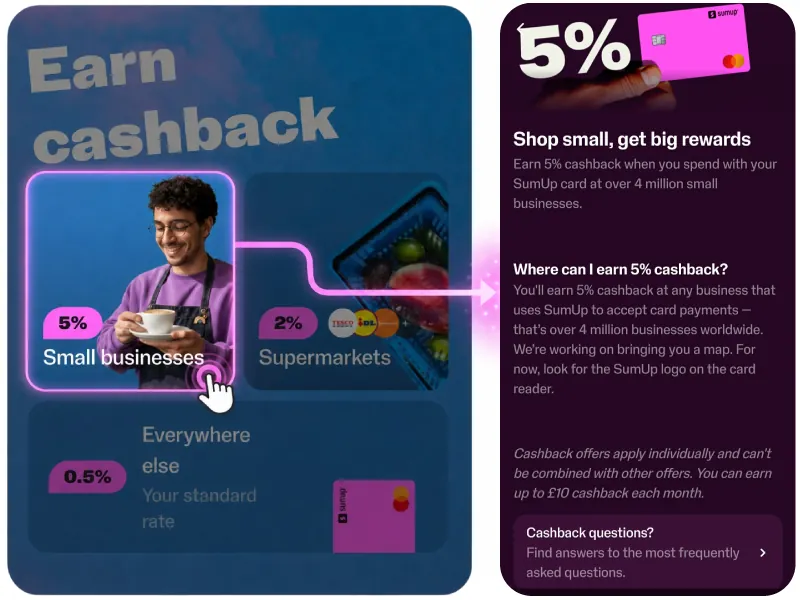
When you tap through to the 5% small businesses category, SumUp now says:
“We’re working on bringing you a map. For now, look for the SumUp logo on the card reader.”
That update is useful, because it confirms SumUp is aware that people need a better way to find eligible 5% cashback retailers. But for now, there still isn’t a searchable retailer list, map, or merchant directory inside the app.
With something like Zilch, you can search for a retailer and see what reward is available before you pay, usually around 2%.
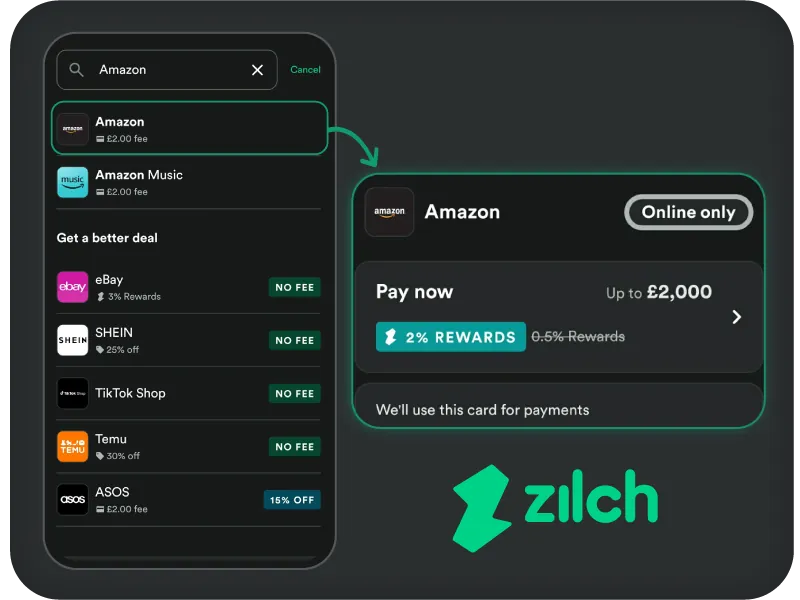
But SumUp doesn’t quite offer that same experience yet. Instead, the current guidance is basically: look for businesses that use SumUp to take card payments.
In practice, that could mean local cafes, barbers, salons, takeaways, food stalls, market stalls, independent shops, and small service businesses. But unless you can see the SumUp logo on the card reader before paying, you may not always know in advance whether a specific purchase will trigger the 5% rate.
That doesn’t ruin the offer, but it does mean I’d treat the 5% cashback as a nice bonus when it lands, rather than something you can perfectly plan every purchase around.
How SumUp cashback works
SumUp cashback is card-based cashback. They provide you with a virtual card, or you can order a physical one. And the spending on that card is what triggers the cashback.
The basic flow is:
Open a free SumUp account.
Verify your identity.
Get your SumUp Mastercard (virtual or physical).
Spend online or in-store.
Cashback goes into a separate cashback balance.
Move the cashback into your main balance when you want to spend it.
That makes it much less fiddly than traditional cashback sites but there's nothing stopping you using both! (more on that later).
Which supermarkets get 2% cashback?
SumUp lists the following supermarkets for cashback:
Tesco
Lidl
Sainsbury’s
Aldi
Asda
Co-op
M&S
Waitrose
Iceland
Morrisons
The important catch: SumUp says the 2% supermarket cashback only applies to grocery purchases. Non-grocery supermarket purchases, including things like fuel, SIM top-ups, car washes and laundry services, earn 0.5% instead.
SumUp + cashback sites for grocery spending
For me, the most interesting use case for SumUp is supermarket spending.
That’s because SumUp pays 2% cashback on supermarket groceries, and supermarket shops are one of the easiest places to stack cashback without making things overly complicated.
For online grocery shopping, cashback sites usually track how you got to the retailer.
SumUp tracks how you paid.
Those are two different layers, which means you can earn both.
The flow looks like this:
Search the supermarket in Bank Boost → click through from the best cashback site → pay with SumUp → earn both cashback layers
For example, right now Rakuten is offering 4.2% cashback at Sainsbury’s, and SumUp pays 2% supermarket cashback, the stack could look like this:
Layer | Cashback rate | On £100 spend |
|---|---|---|
Rakuten cashback | 4.2% | £4.20 |
SumUp supermarket cashback | 2% | £2.00 |
Total cashback | 6.2% | £6.20 |
That’s a much better result than just tapping any old debit card at checkout.
You can still collect supermarket loyalty points too. Nectar points aren't just for nans!
Before placing an online supermarket order, check the Bank Boost cashback comparison tool first. If there’s a decent cashback site rate available, click through from there, then pay with SumUp to add the card cashback on top.
Where SumUp fits for other spending
Aside from the 2% on supermarket grocery purchases, the other obvious use case is paying at local businesses in person.
That’s where the 5% SumUp business rate could be a nice surprise. Based on my understanding, this should apply when the business uses SumUp to take payments, but as mentioned earlier, there does not currently seem to be a clear merchant search or public list showing exactly which businesses qualify.
So for now, I’d treat the 5% rate as a bonus when it appears rather than something you can perfectly plan around.
That may change. SumUp may add a better way to discover eligible 5% merchants in the future, especially if cashback becomes a bigger part of the app.
As for general spending at 0.5%, I’m far less excited.
At that point, I’d usually check Zilch first, as it often offers better Pay Now rewards at specific retailers. Just remember that with Zilch, you normally need to activate the retailer in the app before paying.
My verdict: is SumUp cashback worth it?
Yes, but only for certain types of spending.
The 5% rate is genuinely strong if you spend at eligible SumUp businesses.
The 2% supermarket rate is pretty good, especially because food shopping is regular spending.
The 0.5% everywhere else rate is fine, but I would not get too excited about it.
The £10 cap means SumUp is best used as a targeted cashback card. Use it for small businesses and groceries, then switch to other cashback methods once the cap is hit.
Want to go deeper? Read the full cashback stacking guide to see how cards, cashback sites, gift cards, loyalty points and receipt apps can work together.
SumUp cashback FAQs
What happens if you get a refund?
If you get refunded for a purchase that earned cashback, SumUp says the cashback from that transaction will be deducted from your cashback balance. If you have already moved or spent the cashback, your cashback balance can go negative.
This is normal for cashback cards.
It also means you should not treat cashback as yours forever until the underlying purchase is definitely staying put.
If you return the item, the cashback is going with it.
How much cashback can you earn with SumUp?
You can earn up to £10 cashback per calendar month. SumUp also says the maximum cashback from a single transaction is £10.
Where do you get 5% cashback with SumUp?
The 5% cashback rate applies at SumUp businesses, which are businesses that use SumUp as a payment processing partner. But as of June 2026, there doesn't seem to be a searchable list or partners. SumUp do however say that a searchable map is currently in development.
Which supermarkets pay 2% cashback with SumUp?
SumUp lists Tesco, Lidl, Sainsbury’s, Aldi, Asda, Co-op, M&S, Waitrose, Iceland and Morrisons. The 2% rate applies to grocery purchases, while non-grocery supermarket purchases earn 0.5%.
Does SumUp cashback work everywhere?
Eligible spending outside the 5% and 2% categories earns 0.5%. Exclusions include gambling transactions, crypto purchases and topping up a wallet with another provider.
Is there a minimum spend?
SumUp’s cashback page says there is no minimum spend and no hidden fees.
Do you need to activate SumUp cashback offers?
No. This is card cashback rather than manually activated cashback offers. SumUp says purchases put cashback into a dedicated cashback balance automatically.
Can you stack SumUp cashback?
Yes, but the safest stacks are SumUp plus loyalty points, local rewards and receipt scanning apps. Online cashback site stacking may work where terms allow, but gift card and wallet-style transactions should be tested carefully.
Is SumUp better than Chase, Zilch or Curve?
It depends where you spend. SumUp is strongest at eligible small businesses and supermarkets. Other cards or apps may be better for general spending, online offers or specific retailer rewards.