The Evolution of Klarna: From Buy Now, Pay Later to Everyday Spending App
Klarna is moving beyond Buy Now, Pay Later with cashback, Klarna Balance, the Klarna Card and paid memberships. Here’s what it means for UK cashback users.
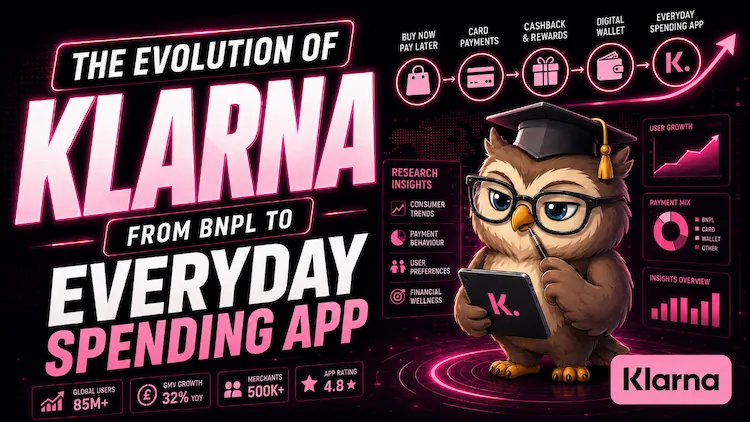
Klarna used to be simple.
You saw it at checkout, clicked Pay in 3 or Pay in 30, and moved on with your day.
But Klarna is starting to look very different now.
We now have:
Klarna Balance
Klarna Card
Cashback
Paid memberships
App-only retailer rewards
Card payments, wallet features, referrals and everyday spending tools.
So this is no longer just a “should I use Klarna at checkout?” conversation.
The more interesting question is:
What is Klarna actually trying to become?
Over the past 5 years, Klarna has been gradually trying to shift its position in your shopping routine. In this article, we’ll look at Klarna’s progression, the smartest ways to make use of its features, how to understand the math behind its new subscription fees, and exactly when it is best to use it.
30-second version
Klarna is no longer just Buy Now Pay Later
Klarna started as an online checkout/payment company in Sweden in 2005.
In the UK, the big shift happened in 2025 when Klarna received FCA e-money authorisation, then launched Klarna Balance and the Klarna Card.
Klarna now offers app cashback, a debit-first card, paid memberships and wallet-style features.
The current Klarna cashback headline is up to 15% at hundreds of stores in the app.
Klarna is useful when its in-app cashback beats cashback sites, or when the Klarna Card fits into a wider cashback stack.
The catch is that Klarna cashback is not the same as simple card cashback. Tracking, payment method, membership fees, service fees and buyer protection all matter.
What Klarna was originally built to do
Klarna was founded in Stockholm in 2005.
The original idea was not “everyday spending app”, “digital wallet” or “cashback ecosystem”.
It was much simpler than that: make online shopping smoother.
Klarna says it started in 2005 and was originally called Kreditor before becoming Klarna in 2010.
For most shoppers, Klarna became known for one thing:
Buy something now, pay for it later.
That could mean paying after delivery, splitting a purchase into instalments, or using Klarna as a middle layer between you and the retailer.
The old Klarna flow looked something like this:
Find something you want to buy.
Go to the retailer’s checkout.
Choose Klarna.
Pay later or split the cost.
Repay Klarna.
That made Klarna useful, but it also made it quite limited.
You usually only interacted with Klarna when the retailer offered it at checkout. If you were shopping somewhere that did not offer Klarna, or spending in-store, or buying everyday essentials, Klarna often was not part of the picture.
That is the bit that has changed.
The Klarna timeline: from checkout button to spending app
Timeline
Klarna timeline
2005
— Klarna launches in Stockholm as an online payments business.
2010
— Kreditor becomes Klarna.
2020s
— Klarna becomes strongly associated with Buy Now, Pay Later.
July 2025
— Klarna receives FCA e-money authorisation in the UK.
October 2025
— Klarna Balance and Klarna Card launch in the UK positioning Klarna as an everyday spending app with a digital wallet and debit-first card.
November 2025
— Klarna cashback launches in the UK, giving users a reason to begin shopping inside the app.
2026
— Cashback, card features, memberships and BNPL regulation become the big story.
The real shift: Klarna wants to own the start of the shop
The most valuable place to be is not always the checkout.
It is before the checkout.
If Klarna can get you to open the app, search for the retailer, click through from Klarna, pay through Klarna and receive cashback back into Klarna, it has much more control over the shopping journey.
The new Klarna loop looks like this:
Open Klarna.
Search for a retailer.
Click through.
Choose how to pay.
Earn cashback.
Cashback lands as Klarna rewards / Klarna Balance value.
Spend again.
That is very different from old Klarna.
Old Klarna was:
Retailer → checkout → Klarna → repayment
New Klarna has become:
Klarna app → retailer discovery → payment → cashback → balance → repeat spending
Key takeaway
Klarna’s cashback is not just a cashback feature. It is a reason to open Klarna before you shop.
Why Klarna is making this move
There are three main reasons Klarna’s evolution matters.
1. Klarna wants more than checkout transactions
Before the Klarna Card and Balance, Klarna was much more dependent on retailers offering Klarna at checkout.
If the retailer did not offer Klarna, Klarna often had no role in the purchase.
A Visa-powered card changes that.
Klarna says the Klarna Card is accepted online and in-store at more than 150 million Visa merchant locations worldwide, and is debit-first by default while allowing eligible users to apply a spending plan when credit makes sense.
That gives Klarna a route into:
online purchases
in-store spending
everyday card transactions
non-partner retailers
travel spending
app-based cashback journeys
Klarna is not just sitting at checkout anymore.
It is trying to sit in your wallet.
2. Cashback changes where people start
Cashback is not just a nice bonus.
It changes behaviour.
If one app regularly shows the best cashback rate, users start opening that app before they shop.
That is the habit Klarna wants.
This is also why the Zilch comparison matters. Zilch already trained users to open the app, choose Pay Now, enable the card and earn rewards. Zilch currently says Pay Now can earn up to 5% back on its standard plan, while Zilch Plus can offer up to 6% when paying now.
Klarna is moving into a similar habit loop, but with a broader set of features:
app cashback
Klarna Balance
Klarna Card
paid memberships
travel-style perks
Pay Later options
wallet features
So yes, Klarna is starting to look more like Zilch in some ways.
But it is also trying to become something wider.
3. Memberships turn Klarna into a packaged spending product
This is one of the biggest changes.
Klarna is no longer just “free Pay Later if you repay on time”.
There are now paid membership tiers with a mix of card, cashback, service fee, travel, subscription and protection-style benefits.
That makes Klarna feel less like a simple checkout button and more like a packaged account, premium rewards card or subscription-based spending app.
That is not automatically good or bad.
But it does mean users need to do the maths.
A cashback rate is only valuable after you account for:
tracking risk
payment method
service fees
monthly membership fees
buyer protection
whether you actually use the perks
The real calculation is:
Real Klarna value = cashback earned − service fees − membership cost − tracking risk
Klarna Balance explained
Klarna Balance is the wallet layer.
Klarna describes Klarna Balance as a digital wallet where customers can store e-money, add funds, transfer funds to a connected card, receive refunds and cashback rewards, and use the balance for Klarna payments.
That means it can be used for things like:
receiving cashback
receiving refunds
holding money inside Klarna
paying for future Klarna purchases
settling Klarna payments
This is important because it keeps more of the shopping loop inside Klarna.
Instead of cashback arriving in a separate cashback account that you withdraw later, Klarna wants rewards to feel more immediate and usable inside the same app.
That can be convenient.
But there is one important protection point.
Important
Klarna Balance is not the same as a normal UK bank account.
It may be regulated and safeguarded as e-money, but Klarna says it is not covered by FSCS protection.
That does not mean you should panic.
But it does mean I would not treat Klarna Balance like a main savings account.
For me, it is more of a spending wallet.
Good for cashback, refunds and small balances.
Not somewhere I’d be parking serious money for no reason.
Klarna Card explained
The Klarna Card is where things get more interesting.
Klarna describes the UK Klarna Card as a flexible debit-first card. Purchases are debit by default, but eligible consumers can apply a spending plan when credit makes sense. Klarna also says the card is powered by Visa Flexible Credential.
In plain English, that means the card is designed to work like debit first.
But in some cases, eligible users may be able to use Klarna payment options such as Pay Later or Pay in 3 for specific purchases.
The basic idea is:
use debit mode when you want to pay now
use Pay Later only when eligible and when it makes sense
use the same card online or in-store
manage the payment mode inside the app
That is clever.
It also means users need to pay attention.
Because “I used the Klarna Card” is not specific enough anymore.
The question is:
Did you use debit mode, or did you use Pay Later?
That matters for fees, credit checks, cashback and purchase protection.
Klarna cashback, Klarna Card and Klarna Balance are not the same thing
This is probably the most important distinction in the whole article.
Klarna feature | What it is | What users often misunderstand |
|---|---|---|
Klarna app cashback | Cashback from starting the shopping journey in the Klarna app at participating retailers | This is not the same as automatic cashback every time you use the Klarna Card. |
Klarna Card debit mode | Paying now, usually from Klarna Balance | Debit mode is not the same as using a traditional credit card. |
Klarna Card Pay Later | Applying a Klarna payment plan to an eligible card purchase | Fees, eligibility and credit checks can matter. |
Klarna Balance | Klarna’s e-money wallet | It is not a normal current account and is not FSCS-protected like a bank account. |
Klarna memberships | Paid monthly plans with extra benefits | The fee can wipe out cashback if you do not use the benefits. |
Does the Klarna Card have fees?
Klarna says there is no monthly or annual fee for signing up for the Klarna Card, and that Pay in full / debit mode is always fee-free.
But Pay Later is different.
Klarna’s UK payment pages say a service fee or paid membership is required to access Klarna Card Pay Later plans, and that Pay in 3 loans with a service fee are regulated credit agreements.
That is one of the big changes users need to understand.
Klarna used to feel like:
Pay in 3 is free if you pay on time.
And at partner checkouts, Klarna still says Pay in 3 lets you split a purchase into three interest-free payments, with no interest or fees if you pay on time.
But Klarna Card Pay Later at non-partner shops can be different.
That does not make Klarna useless.
It just means you need to read the final screen properly.
A small service fee can wipe out a lot of cashback very quickly.
Before using Klarna Card Pay Later
Check whether you are in debit mode or Pay Later mode.
Check whether Klarna is showing a service fee.
Check whether the retailer is a Klarna partner.
Check whether the cashback is worth more than any fee.
Do not use Pay Later just to chase a tiny reward.
Klarna cashback explained
The cashback is the part most Bank Boost users will care about.
Klarna’s current UK cashback page says users can earn up to 15% cashback at hundreds of stores in the Klarna app, then redeem points as Klarna Balance credit or convert them to airline and hotel partners.
That sounds strong.
And in some cases, it probably will be.
But it is important to understand what type of cashback this is.
This is not the same as a simple card paying 1% everywhere.
Klarna app cashback is much closer to cashback site tracking.
You need to start the shopping journey inside the Klarna app.
That means the flow is more like:
Open Klarna.
Search for the retailer.
Tap through from Klarna.
Shop in the Klarna app/browser journey.
Complete the order.
Wait for the cashback to track and confirm.
This is the same broad idea as TopCashback, Quidco or Rakuten.
The click journey matters.
Cookies matter.
Voucher codes can matter.
Returns matter.
Retailer exclusions matter.
Pro tip
Before placing a large Klarna cashback order, screenshot the cashback rate, offer terms and checkout confirmation. If tracking fails later, you will want proof of what you saw before buying.
What happens after you earn Klarna cashback?
This is another part that is easy to overlook.
Klarna cashback is not always instant usable cash.
Klarna says cashback rewards are awarded as points. Those points can be redeemed for Klarna Balance credit, and members may also be able to convert them into selected airline and hotel points.
So the journey can look like this:
You shop through Klarna.
Cashback tracks as pending.
The retailer confirms the transaction.
Returns or cancellations may affect the reward.
The reward becomes available.
You redeem it into Klarna Balance or another eligible reward route.
For most users, the simplest redemption route is Klarna Balance.
For travel-focused users, the airline and hotel partner option may be interesting, but I would only value it if you already know how to use points well.
A point conversion is not automatically better than cash.
Klarna membership plans and pricing
Klarna memberships are one of the clearest signs that Klarna is moving beyond old-school BNPL.
The current UK Klarna Card page lists Standard as free, Core at £4.99/month, Plus at £7.99/month, Premium at £19.99/month and Max at £44.99/month. It also shows increasing claimed annual benefit values across the paid tiers.
Prices and benefits can change, so check Klarna’s current membership page before signing up.
Plan & Price | Best For & Main Perks | The Catch (Watch Out) |
Standard Free | Basic app access, virtual card route, and standard in-app retailer cashback. | No paid perks. Pay Later service fees may apply at non-partner checkouts. |
Core £4.99/mo | Entry-level membership benefits, physical card and standard app cashback. | Costs £59.88/year. Requires regular use to justify the fee. |
Plus £7.99/mo | Mid-tier rewards, card-based cashback benefits, and fee waivers. | Costs £95.88/year. Fee waivers must outweigh the subscription cost. |
Premium £19.99/mo | Premium card cashback, lifestyle perks, and bundled travel benefits. | Costs £239.88/year. It is easy to overvalue the included subscriptions. |
Max £44.99/mo | Highest cashback tier and top-level lifestyle/travel rewards package. | Costs £539.88/year. A major annual financial commitment. |
Membership maths
Do not judge a Klarna membership by the headline cashback alone.
A £7.99/month plan costs £95.88 a year.
A £19.99/month plan costs £239.88 a year.
A £44.99/month plan costs £539.88 a year.
That does not mean they are bad value.
But you should only count benefits you would genuinely use.
A subscription you would never have paid for is not worth its full retail price to you.
Are Klarna memberships worth it?
For most casual users, Klarna memberships should not be the starting point.
The starting point should be:
Is Klarna’s free app cashback the best route for this purchase?
Paid memberships become more interesting if:
you use Klarna regularly
you can avoid meaningful Pay Later service fees
you genuinely use the included subscriptions or travel perks
the card cashback applies to spending you would already do
the quarterly credits or discounts fit your normal shopping
you are not changing your spending just to justify the fee
For many Bank Boost users, Plus is probably the tier to analyse most carefully, because it sits in the middle: not as expensive as Premium or Max, but still costly enough that the benefits need to be real.
Premium and Max should be judged more like packaged bank accounts or premium travel cards.
Do not judge them as simple cashback plans.
If you are only chasing cashback, the maths will often be harder to justify.
The fee that can wipe out your cashback
This deserves its own section because it is where headline cashback can become misleading.
A 5% cashback rate sounds good.
But on a £50 order, 5% cashback is only £2.50.
If a Pay Later service fee appears, the deal can quickly stop being a deal.
The practical formula is:
Real Klarna value = cashback earned − service fees − membership cost − tracking risk
Here is how I would think about it:
Example | Headline reward | What could change the answer? |
|---|---|---|
£50 order with 5% cashback | £2.50 | A small service fee could wipe out the reward. |
£200 order with 8% cashback | £16 | Useful if it tracks, but compare cashback sites and gift card routes first. |
£1,200 laptop with 5% cashback | £60 | Protection may matter more than cashback. |
£7.99/month Plus membership | £95.88/year cost | You need enough real benefits to justify the annual fee. |
The bigger point is simple:
Cashback is not the same as profit if you paid fees, bought things you did not need, or gave up better protection.
The catch: Klarna cashback and cashback sites usually compete
This is the bit cashback stackers need to understand.
If you click through from Klarna’s in-app cashback, Klarna is trying to track the shopping journey.
If you click through from TopCashback, Quidco or Rakuten, that cashback site is trying to track the same shopping journey.
You usually cannot expect both to track on the same online purchase.
One click tends to win.
The other tends to lose.
So the practical rule is:
Use Klarna app cashback when Klarna has the best rate. Use a cashback site when the cashback site has the best rate. Do not assume both will pay.
This is exactly why Bank Boost is useful here.
You do not want to open Klarna, TopCashback, Quidco, Rakuten, Zilch, gift card apps and card-linked apps every time you shop.
You want one place to compare the best route before you buy.
Can Klarna stack with other cashback?
Sometimes, but not always.
The key is to separate app-tracked cashback from card-linked cashback.
Stack | Likely outcome | Bank Boost view |
|---|---|---|
Klarna app cashback + TopCashback / Quidco / Rakuten | Usually no | Both rely on click tracking, so choose one route. |
Cashback site + Klarna Card payment | Usually possible | If you start from the cashback site and simply pay with Klarna Card, the cashback-site route may still track, but Klarna app cashback probably will not. |
Klarna app cashback + retailer loyalty points | Often possible | Loyalty schemes usually depend on your retailer account or loyalty number, not the cashback click. |
Klarna + gift card route | Case-by-case | Gift cards can increase savings, but may break cashback tracking or weaken protection. |
The simplest rule is:
Do not build a complicated stack unless the extra reward is worth the risk.
For small purchases, keep it simple.
For bigger purchases, compare the main routes and choose the one with the best mix of reward, reliability and protection.
Klarna vs Zilch: is Klarna becoming the new Zilch?
This is the obvious comparison.
Zilch has already built a habit around opening the app before paying.
You search for the retailer, enable the card, choose how you want to pay, then earn rewards if the transaction qualifies. Zilch says Pay Now can earn up to 5% back, and its membership terms show the reward structure depends on the plan and whether the card is enabled before checkout.
Klarna is now moving in a similar direction.
But there are differences.
Feature | Klarna | Zilch |
|---|---|---|
Original Identity | Buy Now, Pay Later checkout | Pay Now / Pay Later rewards card |
Current Shift | Broad everyday spending ecosystem | Rewards-led spending card |
Cashback Style | In-app retailer tracking + Card perks | App retailer rewards + Pay Now rewards |
Wallet Layer | Klarna Balance (e-money) | Card/rewards-led balance |
Paid Memberships | Yes (Core, Plus, Premium, Max) | Yes (Zilch Plus) |
Main Catch | Complex fees, tracking risks, payment mode confusion | Must enable card first, reward rules vary by plan |
The simplest way I’d put it is this:
Zilch is still easier to understand as a rewards card. Klarna is becoming a broader spending ecosystem.
That makes Klarna more interesting. But also more complicated.
Good for
Strong app cashback rates when Klarna beats other routes
Planned online purchases
Users who already use Klarna
Cashback paid back into a usable app balance
People who like wallet/card ecosystems
Watch out for
Tracking failures
Pay Later service fees
Paid membership maths
Debit vs credit confusion
High-value purchases where protection matters
The consumer protection bit people should not skip
This is the part that is easy to ignore when cashback is involved.
But it matters.
Klarna is not just one thing anymore. Depending on how you use it, you might be using:
debit mode
e-money balance
Pay Later
Pay in 3
regulated finance
app cashback
membership benefits
Those are not all the same.
BNPL regulation starts in July 2026
The FCA says it will start regulating Deferred Payment Credit, often known as Buy Now, Pay Later, on 15 July 2026.
The FCA has also said BNPL borrowers will benefit from stronger protections from 15 July 2026, after the Government decided to bring the sector under FCA regulation.
That should improve protections for users.
But it does not remove the need to understand what payment mode you are using.
Debit mode is not the same as a credit card
This is the bit I would really pay attention to.
If you use Klarna Card in debit mode, you are not using a traditional credit card.
That can matter for expensive purchases.
Klarna says Klarna Balance is not FSCS protected, and Which? notes that money held with e-money firms is not covered by FSCS in the same way as money held with a bank.
Which? also notes that chargeback can apply to Klarna Card debit purchases, but that BNPL regulation is expected to improve protections from July 2026.
So the practical rule is:
Do not chase a small cashback rate on a big purchase without thinking about protection.
For a £30 fashion order, I would not overthink it.
For a £1,200 laptop, holiday, furniture order or airline booking, I would.
Warning
For expensive purchases, cashback should not be the only thing you consider. Check whether you are using debit, credit, Pay Later or a wallet balance, and make sure you understand the refund and protection route before buying.
Do not use Pay Later just to earn cashback
This is the simplest rule in the whole article.
Cashback should reduce the cost of spending you were already going to do.
It should not make you borrow for something you would not otherwise buy.
If Klarna gives you 5%, 10% or 15% cashback on a purchase you already planned, great.
If it nudges you into using Pay Later for something you do not need, that is not a win.
That is just marketing doing its job.
Is Klarna cashback worth using?
Yes, but only in the right situations.
I would check Klarna when:
I am already making an online purchase
Klarna has a strong in-app cashback rate
the rate beats TopCashback, Quidco, Rakuten and gift card routes
I am comfortable with the tracking risk
I am paying in a way that does not trigger pointless fees
the purchase is not high-risk or protection-sensitive
I would be more cautious when:
the Klarna rate is only slightly better than another route
I need to use Pay Later and there is a service fee
I am buying something expensive
I am relying on cashback to make the purchase affordable
I am paying for a membership just to chase small cashback
another cashback site has a cleaner or higher route
My verdict: Klarna is no longer just BNPL
Klarna is worth paying attention to again.
Not because every user should suddenly move all spending to Klarna.
But because Klarna has changed.
It now has enough moving parts to be relevant to cashback users:
app cashback
Klarna Card
Klarna Balance
paid memberships
referral offers
Pay Later options
wallet features
retailer discovery
That makes it much more interesting than old Klarna.
But also much easier to misunderstand.
For me, Klarna fits best as a targeted cashback route.
I would check it before planned online purchases, compare the rate against Bank Boost’s cashback tool, and use it when the Klarna route is clearly better.
I would not blindly use Klarna for everything.
And I definitely would not use Pay Later just to chase rewards.
Bank Boost verdict
Klarna is worth checking, not blindly defaulting to
Klarna’s move from BNPL checkout button to everyday spending app is a real shift. The cashback can be useful, especially when Klarna’s in-app rate beats other routes. But for most Bank Boost users, the best approach is still to compare first, use the strongest reliable route, avoid unnecessary Pay Later fees and be careful with expensive purchases where protection matters.
Klarna evolution FAQs
What changed with Klarna in the UK?
Klarna has moved beyond a simple Buy Now, Pay Later checkout option by launching Klarna Balance, the Klarna Card, cashback, memberships and everyday spending features in the UK. Klarna launched Klarna Balance and the Klarna Card in the UK in October 2025, after receiving UK e-money authorisation earlier that year.
When did Klarna first launch?
Klarna was founded in Stockholm in 2005. It was originally called Kreditor before becoming Klarna in 2010.
Is Klarna still Buy Now, Pay Later?
Yes. Klarna still offers Buy Now, Pay Later products, but it now also has wallet, card, cashback and membership features.
What is Klarna Balance?
Klarna Balance is Klarna’s digital wallet. Klarna says it lets users store e-money, add and withdraw funds, receive refunds and cashback rewards, and use the balance for Klarna payments.
Is Klarna Balance a bank account?
No. Klarna Balance is an e-money balance, not a normal UK current account. E-money safeguarding is different from FSCS protection, so I would treat it as a spending wallet rather than somewhere to hold serious savings.
What is the Klarna Card?
The Klarna Card is a debit-first card. Klarna says purchases are debit by default, but eligible users can apply a spending plan when credit makes sense. The card is powered by Visa Flexible Credential.
Is the Klarna Card debit or credit?
The Klarna Card is debit-first by default. Credit or Pay Later options may be available for eligible purchases, but that is different from simply using debit mode.
Does the Klarna Card have fees?
Klarna says there is no monthly or annual fee for signing up for the Klarna Card, and debit mode is fee-free. However, Klarna also says fees may apply if you sign up for a paid membership or use certain Pay Later plans.
How does Klarna cashback work?
Klarna cashback is earned by shopping through the Klarna app at participating retailers. Klarna says cashback rewards are awarded as points and can be redeemed as Klarna Balance credit or other eligible benefits.
Do you need to start in the Klarna app to earn Klarna cashback?
For Klarna app cashback, you should expect to start the shopping journey inside the Klarna app. If you go directly to the retailer and simply pay with a Klarna Card, the in-app cashback route may not track.
Can you stack Klarna cashback with TopCashback or Quidco?
Usually, you should not assume Klarna in-app cashback will stack with TopCashback, Quidco or Rakuten, because they rely on competing tracking journeys. Compare the rates first and choose the strongest reliable route.
Can you stack Klarna with loyalty points?
Often, yes. Retailer loyalty schemes usually track your retailer account or loyalty number, not just how you paid. You may still be able to collect Clubcard, Nectar, Boots Advantage Card or similar points when paying through Klarna, depending on the retailer’s terms.
Are Klarna memberships worth it?
They can be, but only if you genuinely use the benefits. Klarna’s paid tiers can include card, cashback, fee-waiver, lifestyle, subscription or travel-style perks, but the monthly fee needs to be included in the cashback maths. Klarna’s current UK Card page lists Core at £4.99/month, Plus at £7.99/month, Premium at £19.99/month and Max at £44.99/month.
Is Klarna better than Zilch?
It depends. Klarna may be better when its in-app cashback rate is higher or when you want its wider wallet/card ecosystem. Zilch may be better when Pay Now rewards are clearer, simpler or stronger for a specific retailer. Compare before choosing.
Is Zilch still useful for cashback?
Yes. Zilch can still be useful when the merchant is in the app, the Pay Now reward is strong, and you enable the card before checkout. Zilch says Pay Now can earn up to 5% back on the standard plan, while Zilch Plus can offer up to 6%.
Should I use Klarna for expensive purchases?
Be careful. For expensive purchases, cashback should not be your only concern. Check whether you are using debit, credit, Pay Later or a wallet balance, and make sure you understand the buyer protection route before buying.
When does BNPL regulation start in the UK?
The FCA says it will start regulating Deferred Payment Credit, often known as Buy Now Pay Later, on 15 July 2026. Agreements taken out before that date will remain unregulated, and the new protections will not apply to those agreements.
Is Klarna worth using for cashback?
Klarna can be worth using when its in-app cashback rate beats other routes and the purchase is something you were already going to make. It is less useful when the cashback is small, tracking is uncertain, a service fee applies, or the purchase needs stronger protection.
Roadmap unavailable
This roadmap is not currently available publicly.