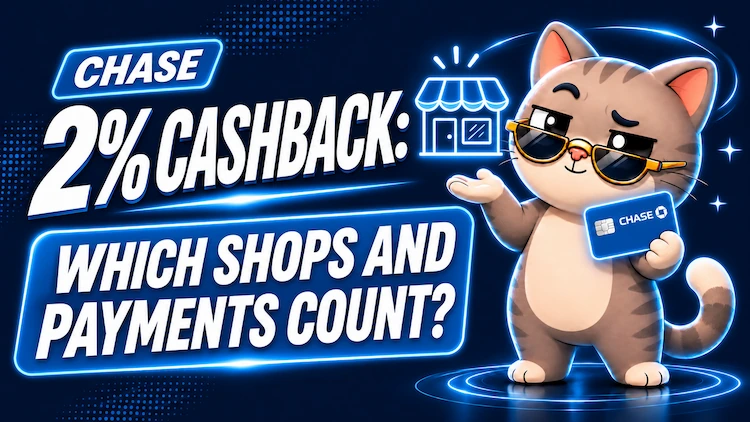
Chase 2% Cashback: Which Shops and Payments Count?
Chase offers 2% cashback up to £20 a month, but MCCs matter. See which shops, categories and payment routes are safest.
Last checked 26 November 2026
I’ve been looking at cashback cards for the days when you just want to pay for your shopping and go home. I like a good payment chain, but I can see the appeal of getting something back just by tapping one card.
Chase caught my eye because a £100 food shop at Sainsbury’s could earn £2. Then I read what happens if you walk over to the Argos counter inside the very same supermarket. Chase specifically excludes that purchase.
That’s the bit I wanted to get straight. When would I actually reach for Chase, and how much of that £20 monthly cap could I earn on spending I’d do anyway?
Chase pays 2% on eligible groceries, restaurants, cafés, takeaways, everyday transport, fuel and public EV charging. Pay at least 50p in sterling with a qualifying Chase debit or credit card in the UK or Channel Islands. The cashback cap is £20 a month across your cards.
After a grace period for new customers, you qualify a month ahead. You need 15 card payments or Direct Debits in the previous calendar month and at least £1,000 across qualifying Chase savers every day of that month. Chase cashback terms
Which shops earn 2% Chase cashback?
Chase gives examples of businesses in each category. That makes its list useful when you’re deciding how to pay, especially where two shops in the same building sell quite different things. These are the examples I’d want to remember at the till.
Where you spend | Examples Chase names | The detail to watch |
Supermarkets and food shops | Sainsbury’s, Tesco, Waitrose, Costcutter, Londis and Spar | Supermarket concessions such as Argos, Habitat and Timpson are excluded. Specialist alcohol merchants are excluded too. |
Restaurants and cafés | Nando’s, Wagamama, Dishoom, Pret and Costa | An independently run café inside a venue is likely to qualify. A café run by the venue itself is likely to be excluded. |
Takeaways | Deliveroo, Uber Eats and Domino’s Pizza | Takeaways can qualify even when you order online. See the payment route guidance below. |
Everyday travel | TfL, Oyster top-ups, Trainline, Eurostar, buses and ferries | Rail and local public transport are included. Taxis are excluded. |
Fuel and EV charging | BP, Esso, Shell and public chargers such as GRIDSERVE and Pod Point | Petrol at major supermarkets is included. Charging your car at home is excluded. |
The list comes from Chase’s shop and payment guide.
What about Aldi, Lidl, Asda or Morrisons?
Grocery stores and supermarkets are an eligible category. Chase names Sainsbury’s, Tesco and Waitrose as examples. It doesn’t give a branch-by-branch list, so the absence of your supermarket’s name tells you very little on its own.
What determines the result is the merchant category code, usually shortened to MCC. This tells Chase what kind of business took the payment. Chase uses that code to award cashback and says it doesn’t choose which code a business gets.
That explains the Sainsbury’s example. Pay the supermarket for your groceries and the transaction can earn 2%. Pay Argos for a kettle on your way out and the fact that you’re still under the same roof doesn’t turn it into a grocery purchase.
The operator can matter for food too. Two people could buy coffee at the same garden centre, one from a visiting café chain and one from the garden centre’s own restaurant. Chase says the first is likely to qualify and the venue-run restaurant is likely to be excluded. I wouldn’t count the cashback in advance if I couldn’t tell who was taking the payment.
How do the 15 payments and £1,000 savings rules work?
There are two separate £1,000 figures in this offer. One is savings you hold to qualify. The other is eligible spending that would earn the full £20. You can spend much less than £1,000 and still earn cashback.
Chase advertises the offer to eligible UK residents aged 18 or over with a Chase current account and saver account. When you first join, you get the rest of your joining month and the whole of the next calendar month as a grace period. Eligible card purchases can earn cashback straight away during that period. Chase offer details
Say you join on 26 November. Eligible spending can earn cashback for the rest of November and throughout December. To keep earning in January, you need to meet both requirements in December.
First, make at least 15 payments in total using your Chase debit card, credit card or Direct Debits. Second, keep at least £1,000 across your Chase saver accounts every day of December. Moving £1,000 over on 31 December won’t cover the earlier days. Current-account and round-up balances don’t count. The Chase Regular Saver does count towards the combined total.
Sources: Monthly qualification terms · Chase on the Regular Saver
Which payments count towards 15?
This is where the example in pounds makes more sense to me than the words “qualifying payment”. A £50 gym Direct Debit can get you one payment closer to 15. It earns £0 cashback. A £50 eligible supermarket card payment can also count towards the 15 and, if you’re earning cashback that month and still under the cap, put £1 in Rewards.
Payment | Counts towards 15? | Can earn 2%? |
Chase debit or credit card payment | Yes | Yes, on eligible purchases of 50p or more. |
Direct Debit | Yes | No. |
Bank transfer or standing order | No | No. |
Refund | No new count. The original payment stays in the count. | No. Cashback credited on the refunded amount is deducted. |
That means you can reach 15 using a mix of purchases and bills. For instance, 12 ordinary card payments and three Direct Debits get you there, even if some card purchases fall outside the cashback categories. A payment counts on the day you make it, including one still pending at the end of the month.
Sources: Chase’s rules on pending payments and refunds
Can I use Apple Pay, PayPal, Curve or Klarna?
Chase lists Apple Pay, Google Pay and PayPal as supported digital wallets. If you use your Chase card through one of them, the purchase still needs to meet the usual cashback conditions. So if you normally tap your phone for the weekly shop, you can keep doing that.
Sources: Chase cashback FAQ
I’d be more careful with Curve or Klarna. In the supermarket section of its guide, Chase specifically says you might miss out on cashback when paying through either. If the Chase reward is what I’m after, that’s a good reason to pay the supermarket directly with Chase. I’d treat a gift card bought at the till as unconfirmed too. The published guidance doesn’t settle that particular case.
When is the cashback paid and how much can I earn?
Once the card payment clears, Chase credits your Rewards balance. From there you can transfer the money to an account you hold with Chase and spend it. That’s why a payment can already count towards your 15 while you’re still waiting to see the cashback.
Sources: Chase cashback terms
£250 of eligible spending in a month earns about £5. At £500, it’s about £10. At £1,000, you reach about £20, the monthly cap. These examples assume you qualify and have the full cap available. Chase rounds each transaction’s cashback to the nearest penny.
I’d start with the amount I actually spend. If £250 of my regular monthly spending would qualify, that’s roughly £5 a month. That’s useful if I already keep savings with Chase and use the account for bills. If I’d have to move my savings and change how I pay just to get that fiver, it’s a different decision.
Example spending
Purchase amount x confirmed rate = expected saving
Example: £100 x 2% = £2 cashback
My verdict on Chase 2% cashback
I’d put Chase near the front of the wallet for groceries, fuel and train fares if those were already regular purchases and I met the monthly rules. The £20 cap is the ceiling. There’s no reason to buy anything extra to reach it.
For someone weighing Chase against SumUp, the weekly shop is a good place to compare them. SumUp also advertises 2% on eligible supermarket groceries but caps its cashback programme at £10 a month. Chase has more headroom if you qualify. If you’re interested in small shops that take SumUp payments, that’s where SumUp’s higher headline rate becomes relevant.
Bank Boost’s SumUp cashback guide · SumUp cashback terms
For an online purchase, there’s another option. You may be able to click through a cashback site and then pay the retailer with Chase. Check that the order qualifies for the portal offer and the payment qualifies for Chase. I’d do that comparison before checkout, particularly for a larger order.
Buying online? Look up the shop in Bank Boost to compare the available cashback-site offers before you pay.
Bank Boost · Free tool
Same shop. Better cashback.
Check cashback sites side by side before your next online shop.
Free to compare. No account needed.
Chase cashback FAQs
What if I only made 14 payments last month?
Outside the new-customer grace period, you need at least 15 in the previous calendar month. Fourteen in November won’t qualify you for December. You can meet the conditions in December to qualify for January.
Can I earn cashback on spending abroad?
Chase specifies sterling card purchases made in the UK or Channel Islands. Paying in pounds while travelling elsewhere doesn’t satisfy the location requirement.
Does Just Eat earn Chase cashback?
Takeaways are an eligible category. Chase specifically names Deliveroo, Uber Eats and Domino’s as examples. Just Eat isn’t named in that guide, so I’d check the cleared payment in Rewards before relying on it for future orders.
Does using both Chase cards give me two £20 caps?
The monthly £20 cap covers eligible debit and credit card spending together. Once you’ve reached it, further spending on either card won’t earn more under this offer that month.
What if an eligible purchase hasn’t earned anything?
Start with the transaction itself. Has it cleared, was it at least 50p and did you still have room under that month’s £20 cap? Then check your qualification for the month and the merchant category. If you expected cashback based on those checks, ask Chase about that specific payment. If it’s the separate cashback-site reward you’re missing, use Bank Boost’s guide to missing cashback.