Trading 212’s 1.5% Cashback Is Ending—What Happens Next?
Trading 212’s 1.5% card cashback ends on 3 December 2026. Here’s what happens to your rewards, what continues and which alternatives to compare.
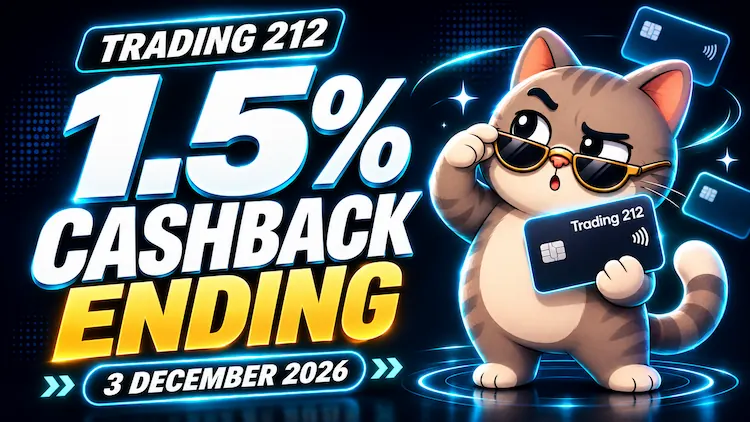
Trading 212 is ending its 1.5% card cashback programme on 3 December 2026. If you’ve been using the card for everyday spending, that’s a reason to review where your next shop goes.
Your card will still work, and some retailer-specific cashback is staying. The decision is which rewards are worth keeping and what to use for the rest of your spending.
30-second version
The change at a glance
The 1.5% programme runs until 2 December; its rate becomes 0% from 3 December.
Outstanding cashback already earned will be paid as usual.
The card and subscriptions continue. Separate merchant-funded offers remain for eligible UK customers.
Those details come from Trading 212’s official closure notice. This article focuses on UK readers.
What is changing with Trading 212 cashback?
Think of this as the end of one reward programme. It’s worth separating that from the card itself and from offers tied to individual retailers.
Until 2 December 2026
1.5% on eligible spending when both qualifying conditions are active.
Monthly cashback cap: £15 for GBP accounts.
From 3 December 2026
The closing programme pays 0%.
Merchant-funded cashback continues separately for eligible UK customers.
A rate attached to a particular shop isn’t a replacement for a general spending rate unless you actually shop there. That matters when you compare the alternatives below.
Can you still earn 1.5% before it ends?
Yes, subject to the existing eligibility rules. You need both Invest cashback enabled and an active qualifying subscription detected on the card. Check the app’s eligibility status; simply adding a payment does not guarantee it qualifies. Annual subscriptions don’t count: the supported recurring cycle is between five days and one month.
There’s another important detail: rewards under this programme are automatically invested into a Pie, rather than paid as cash to your spending balance. Their value can fall as well as rise.
Here’s what the rate means for planned purchases, before investment movements:
Eligible spending | Reward at 1.5% |
|---|---|
£200 | £3 |
£500 | £7.50 |
£1,000 | £15 — monthly cap |
There’s no saving in spending £200 you wouldn’t otherwise spend to collect £3. Equally, paying for an unwanted subscription just to qualify can eat into the benefit. Use the remaining window for normal purchases if you already meet the conditions.
Is all Trading 212 cashback disappearing?
No. Merchant-funded cashback is separate: it remains available to UK-resident customers registered with Trading 212 UK Ltd who have opted into that programme. Check the actual retailer offer before relying on it.
That gives you two different decisions: whether a particular offer is useful, and which card to use for spending outside those offers. You don’t have to answer both by choosing the same provider.
What could you use instead?
I’d start with where your money goes, rather than which app has the biggest percentage in its advert. These are options to compare, not a complete market ranking. All figures below were researched on 4 November 2026.
UK spending alternatives
Match the reward to your spending
Read the conditions below before choosing. Zilch pays spending rewards rather than withdrawable cash.
Option | Reward | Main catch |
|---|---|---|
SumUp | 5% / 2% / 0.5% | £10 monthly cap; rates vary. |
Chase | 2% | £20 monthly cap; see rules below. |
Zilch Standard | 2%* | Enable shop; else 0.5%. |
Zilch Plus | 3%* | £4.99 a month; enable shop. |
*Zilch figures are minimum Pay Now rates with the merchant enabled. Other transactions earn 0.5%. Check account access, offer terms and exclusions. Sources are linked in each explanation.
Bank Boost · Free tool
Same shop. Better cashback.
Check cashback sites side by side before your next online shop.
Free to compare. No account needed.
SumUp: compare it for groceries and eligible small businesses
SumUp’s support guidance lists 5% at businesses using SumUp to accept payments, 2% at supermarkets and 0.5% on other eligible purchases, with a £10 monthly cap. Its personal account page advertises no monthly fee.
Check the app for transaction eligibility, particularly when a purchase isn’t ordinary grocery shopping. The cap covers all three rates together, so earning rewards at small businesses leaves less room for grocery cashback. Read our full SumUp cashback explainer for more detail.
Chase: a wider set of everyday categories, with conditions
Chase’s terms offer 2% on eligible sterling purchases in the UK and Channel Islands across groceries, everyday transport, fuel and EV charging, restaurants, cafes and takeaways, capped at £20 monthly. Eligible transactions must be at least 50p.
Outside the new-customer grace period, you need 15 qualifying card or Direct Debit payments and at least £1,000 across Chase saver accounts every day of the previous calendar month. Check merchant-category and wallet restrictions too.
The practical question is whether those requirements already fit your banking. If you’d move savings solely for cashback, compare the interest you’d receive elsewhere before deciding.
Zilch: compare the free plan before paying for Plus
The November membership terms list minimum Pay Now rewards of 2% on Standard and 3% on Plus when you enable the retailer. Other transactions earn 0.5%. Standard has no membership fee; Plus costs £4.99 monthly. Plan access is being rolled out.
Rewards cannot be withdrawn as cash. Zilch also requires an active credit account; this comparison concerns paying now, not borrowing to earn rewards.
If the difference on your purchases is exactly one percentage point, you’d need £499 of eligible monthly spending to recover the Plus fee from that uplift alone. At £300, the extra £3 wouldn’t cover £4.99. Value other perks only if you’d actually use them.
How I’d choose a replacement
Start with a normal month’s groceries. On £300 of fully eligible spending, a 2% rate produces £6, compared with £4.50 at 1.5% before investment movements. That’s an extra £1.50, assuming you meet the conditions, haven’t reached the cap and pay no extra fee.
That puts the percentages in perspective. Then add travel, eating out and other purchases, applying the right rate to each category. Deduct fees and any benefits you’d give up elsewhere.
Two cards can make sense if the extra reward is worth the effort. But a slightly lower rate that you reliably earn may be more useful than a higher one you regularly forget to activate.
Before changing cards
Check the whole deal
Use your normal monthly spending, not an optimistic budget.
Check eligibility, activation steps, exclusions and reward caps.
Subtract membership fees and compare any savings-interest trade-off.
Distinguish cash, spending rewards and invested rewards.
If considering a credit card, include interest and repay in full to avoid it.
For online shopping, check the Bank Boost cashback comparison tool for retailer cashback-site offers too. Our cashback stacking guide explains how different reward layers can work together, where the terms allow. The tool compares cashback sites rather than payment cards.
Bank Boost verdict
Replace the reward around your real spending
Compare SumUp for groceries and eligible small businesses, Chase if its monthly conditions fit, and Zilch if you’ll use its retailer rewards. Start with fee-free options. Keep a paid plan only when the extra value justifies its cost.
Trading 212 cashback FAQs
What happens to cashback I’ve already earned?
Trading 212 says outstanding cashback earned before closure will be paid as usual. That doesn’t turn invested rewards into a guaranteed cash balance.
Do I need to close my card or move subscriptions?
No. Both continue working. Review subscriptions on their own merits, rather than moving them simply because a reward changes.
Where can I check rewards I’ve earned?
Open the Card tab and look under Your cashback. Trading 212’s reward guidance also explains transaction-level details and refund adjustments.
Sources & checks
Research checked: 4 November 2026
Official sources: Trading 212 notice; eligibility; SumUp; Chase; Zilch.
Based on published provider information, not hands-on testing. Offers and conditions can change; confirm them before applying or spending.